LONG READ
The Terraces Keep Two Calendars
High up in the Cordillera, the planting schedule and the project deadline run side by side. Neither has displaced the other — yet.
THE PROVINCES
Water, Stone, and Wi-Fi
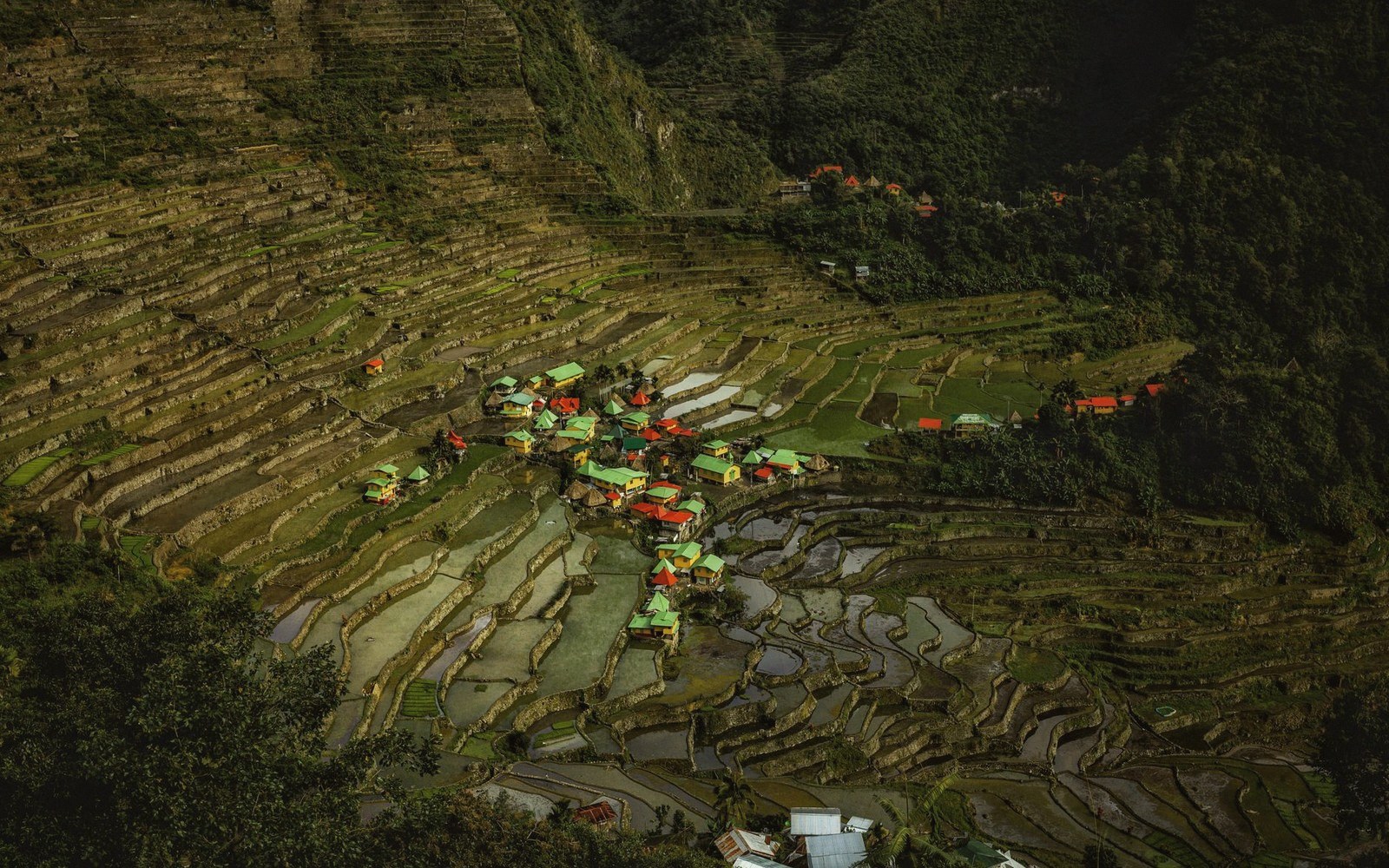
The Ifugao rice terraces were built into the mountains of northern Luzon over centuries, their exact origins still contested by historians but their scale beyond dispute: somewhere around ten thousand hectares of carved and irrigated hillside, maintained by a water-management system — the muyong, the privately owned forest watershed above each terrace cluster — that functions without a single pump or pipe. The terraces were inscribed as a UNESCO World Heritage Site in 1995. They are still farmed today. They are also, increasingly, within mobile signal range.
That proximity — old stone and new bandwidth — is not metaphor. It is the daily condition of communities in Banaue, Batad, Hungduan, and Kiangan, where households can contain a grandmother who reads the sky for planting cues and a grandson who logs on before sunrise to take calls from somewhere in North America. The two schedules do not cancel each other. They run in parallel, and the tension between them is what shapes this generation's choices.
The Cordillera Administrative Region has always been geographically apart — no lowland-style hacienda history, no Spanish colonial grip that reached far into the mountains. The Ifugao and Kankanaey and Bontoc peoples maintained their own political and land-tenure systems. That separateness is part of what preserved the terraces; it is also part of what made the outmigration of young people so sharp when it eventually came. Baguio City, roughly six to eight hours south depending on your road and your nerves, became the first waypoint. Manila came after. Then, for many, overseas.
The Calendar the Terraces Run On
Rice cultivation in the Cordillera does not follow a single national schedule. At the elevation of the Banaue terraces — roughly a thousand metres above sea level — the growing cycle is calibrated to mountain weather, not lowland monsoon logic. Planting in many communities happens once a year, typically between December and February, with harvest running from June into August depending on the variety and the altitude of the specific terrace. The muyong system means each family manages their own water source; timing is individual as well as communal, negotiated with neighbors whose fields sit above or below yours on the same slope.
Maintaining a terrace is physical and relentless work. The stone walls — pongpong in Ifugao — require constant inspection and repair, especially after heavy rain. Mud walls can be rebuilt; stone walls demand skill, and the knowledge of how to read a failing section is not written down anywhere. It passes between people who work the same land across generations. When a family's young adults leave, that knowledge either pauses or goes with an elder who cannot always act on it alone. Across the Ifugao terraces, wall collapse and terrace abandonment have been documented concerns for decades, linked directly to depopulation of working-age farmers.
This is not a simple story of neglect. Some families who have members working remotely — or sending remittances from the city or abroad — use that income to hire mamamahay, local laborers, to maintain terraces they can no longer work themselves. The money that comes in from outside sometimes keeps the water running inside. But it is a substitution, not a continuation, and it depends on there being enough people left in the community willing to do the physical work.
The Calendar the Laptop Runs On
The digital economy arrived in the Cordillera unevenly, as it arrived everywhere outside Metro Manila. Baguio — a chartered city, a long-established university town, home to Saint Louis University and the University of the Cordilleras — has had a functioning BPO sector and a freelance contractor population for years. The mountain provinces above Baguio are different: connectivity is patchier, power more vulnerable to weather, and the cost of a stable remote setup higher relative to local income.
But the connectivity did come, and it changed what was possible. A young person from Banaue no longer needs to move to Manila to access online work. They may need to move to a spot in their house with a better signal, or invest in a pocket Wi-Fi device, or time their heaviest uploads to early morning before the local network slows. These are workarounds, not solutions, but they are workarounds that work often enough to have changed the calculus.
What remote work offers someone in a Cordillera community is not just income — it is the option to stay. Or to come back. The return migration pull that is visible elsewhere in the Philippines — skilled workers trading Metro Manila congestion for provincial life — takes a specific form in the mountain provinces, where the thing you might return to is not just a slower pace but an actual piece of land with an actual obligation attached to it.
The workers who come back to the Cordillera with remote contracts tend to be doing knowledge work: writing, design, software development, virtual assistance, customer support on non-voice channels. They are not the BPO floor workers tied to physical infrastructure and shift rotations managed by a site director — they are independent contractors or employees of companies that have normalized distributed work. Their income is in foreign currency; their expenses are in pesos; the exchange rate psychology that shapes decisions for remote workers everywhere applies here too, with the added variable that local cost of living in the mountain provinces is lower than Manila but the cost of reliable connectivity is proportionally higher.
What Coexistence Actually Looks Like
It would be easy to tell this as a story of two worlds in collision, tradition versus modernity, the terrace versus the screen. That framing is too clean. The families living this are not experiencing it as a philosophical conflict. They are making practical decisions under real constraints, and the decisions vary household by household.
In some households, the division of labor is explicit: one sibling manages the farm, another earns remotely and contributes financially. This is not a new structure — versions of it existed when one sibling went to Manila and sent money home — but remote work makes the absent sibling less absent. Video calls happen. Decisions about the terrace get made over a messaging app. The person earning in dollars is sometimes the one who coordinates the hiring of seasonal labor for planting.
The cultural calendar matters here too. The Ifugao agricultural rituals — Imbayah, the harvest festival, and the cycles of prayer and offering tied to each stage of the rice crop — are not merely ceremonial. They are the mechanism by which the community's relationship to the land is renewed and transmitted. A young contractor who stays in the province, or who returns to it, participates in these cycles in a way that someone in Makati does not. Whether participation sustains the knowledge or whether it is becoming more ceremonial than functional is a question communities are living through right now, without a clean answer.
Tourism adds another layer. Banaue and Batad attract visitors year-round, and the tourism economy has created work — guiding, homestays, transport — that sits somewhere between the agricultural and digital economies. A local guide who speaks English well and knows the terrace trails is not farming and is not doing screen work, but they are monetizing exactly the landscape that farming built. Some remote workers in the province take guiding work during slow client periods. Some farmers guide tourists on weekends. The calendar is less two competing systems and more a set of overlapping demands that require constant personal scheduling.
What is genuinely at risk is not the terraces themselves — the stone is durable, and there is real community will to maintain what exists, supported by local government, national agencies, and international heritage attention. What is at risk is the population density of skilled farmers needed to keep the water-management system functioning without substitution. The muyong is not a metaphor for indigenous knowledge; it is a technical system that requires people who know how to read it and act on it, season after season, in the specific microclimate of a specific mountain slope.
The young contractor logging on at five in the morning to catch a European client's working hours, watching daylight come up over terraces her grandparents carved into shape — she is not choosing between two worlds. She is trying to occupy both, and for now, in enough households across the Cordillera, that is what is happening. Whether the arithmetic holds over the next generation is the question the terraces are quietly asking.