REPORTED
What Stays, What Goes
When Filipino workers move abroad, some things cross the border intact. Others dissolve quietly, and nobody announces when they're gone.
DIASPORA
The Carry-on Items
Language is the first thing people expect to lose, and the first thing that proves them wrong. Tagalog and the regional languages — Bisaya, Ilocano, Kapampangan — tend to survive relocation stubbornly, protected inside households, group chats, and the Filipino community wherever it lands. What actually changes faster is the mixing pattern. Taglish, the fluid code-switching that characterises how Filipinos move between Filipino and English mid-sentence at work and at home, often becomes more pronounced abroad rather than less. Cut off from the daily pressure to perform full English for a local audience, and shielded from any pressure to perform pure Filipino for family in the provinces, some diaspora Filipinos find their speech settles into a comfortable hybrid that no longer apologises for itself.
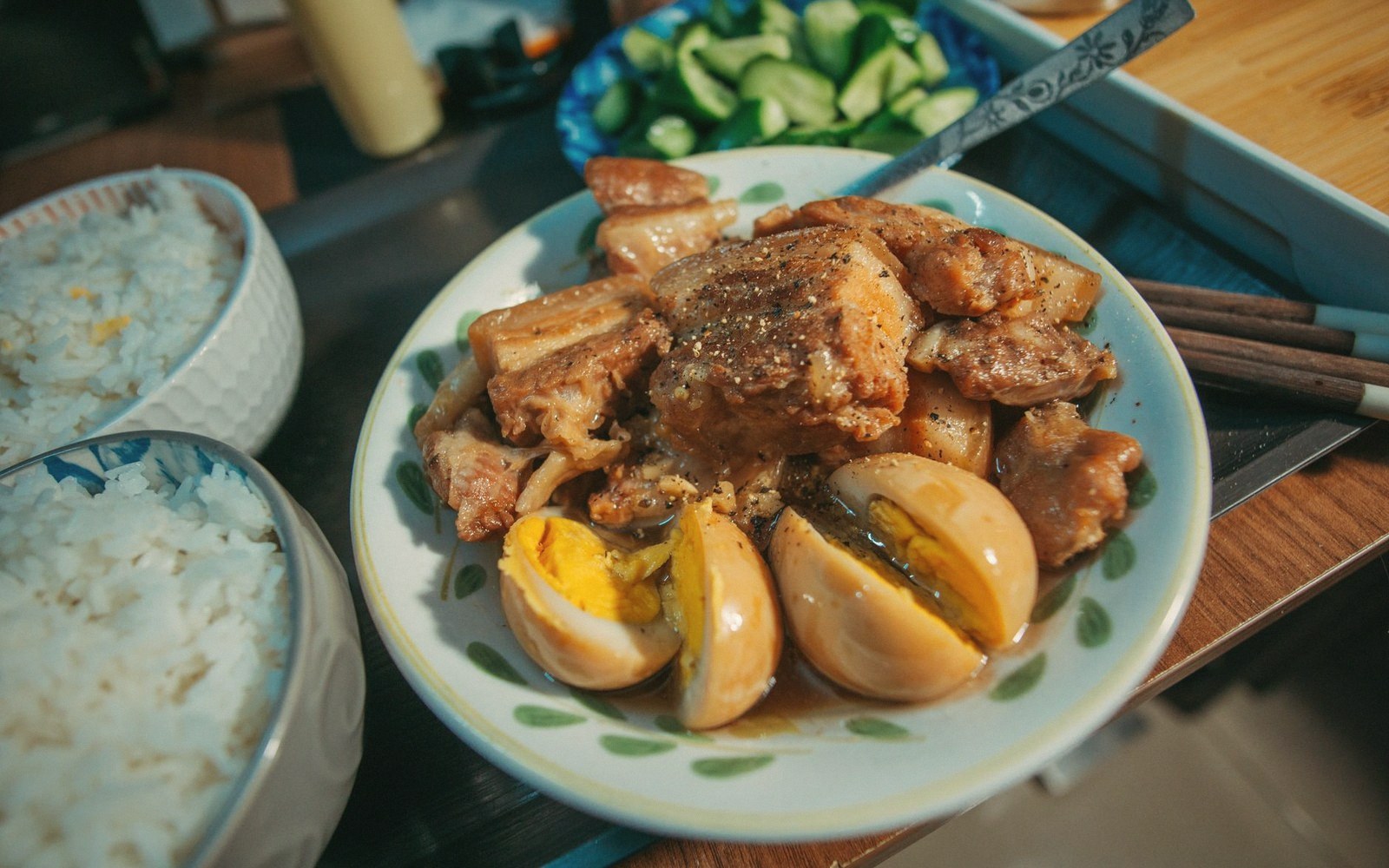
Food habits are more complicated. The craving is immediate and lasting — that specific sourness of sinigang, the exact sweetness of condensed-milk desserts, the ritual of rice with every proper meal. What changes is the infrastructure around the craving. In Metro Manila, a carinderia is a two-minute walk from most apartments; the ulam economy is a living, daily system that feeds workers who don't have time to cook. Abroad, that system collapses. A Filipino worker in a mid-sized European or North American city might spend a weekend afternoon cooking a week's worth of adobo that would have taken minutes to pick up at home. The food itself persists; the ease and the social texture around it do not. The meal becomes something you make alone, for preservation, not something you walk out and find.
What the Workplace Does to You
Professional norms are where the real negotiation happens, and where it's hardest to see clearly while you're inside it.
Filipino working culture carries a strong orientation toward collective harmony — the practice of reading a room, not pushing back directly, softening disagreement through indirection. In a BPO context or a local office, this functions efficiently: teams understand each other, hierarchy is legible, and smooth operation depends partly on that shared social grammar. Cross a border and that grammar no longer has an obvious counterpart. A diaspora worker in a Dutch or Australian or American workplace can find that what reads at home as professional courtesy reads abroad as passivity, or worse, as confusion about the work itself.
The adjustment is real, and it cuts both ways. Some Filipino workers describe the foreign workplace as liberating — a context where speaking up is not read as aggression, where the hierarchy is genuinely flatter. Others find the directness grating, or feel a persistent low-level dissonance between what they're expected to perform at work and who they are at home. Neither experience is wrong; both are honest accounts of what happens when a cultural operating system meets a different environment.
What tends to survive professionally is work ethic in the plainest sense: the willingness to put in the hours, to adapt quickly, to be reliable under pressure. These aren't uniquely Filipino qualities, but they are ones that Filipino workers carry with them and that transfer without loss across contexts. What travels less well is the expectation that good work will be recognised without having to be named. In a culture where self-promotion reads as boastful, the instinct is to let the output speak. In workplaces that run on visible advocacy — on speaking up in meetings, on making the case for your own contribution — that instinct can become a practical disadvantage.
The Identity Question Nobody Resolves
The harder argument is about what happens to identity over time, not just in the first year but in the fifth and the tenth.
First-generation diaspora Filipinos tend to hold the culture consciously — they know they're carrying it, and they make choices about which parts to pass on and which to let go. It's an active process, sometimes exhausting. The second generation inherits a version that has already been filtered, shortened, translated. They may have the food without the language, or the language without the professional context, or the community feeling without the regional specificity that makes Filipino identity genuinely complex at home. Bisaya pride doesn't quite mean the same thing in Toronto that it does in Cebu.
None of this is tragedy. Cultures have always moved and changed through migration; what's specific to the Filipino case is the sheer scale of it, and the degree to which the connection home remains live — through remittance practices that function as structural ties, through video calls, through the news arriving in real time. The diaspora is not a sealed-off community quietly losing its Filipino-ness; it is a community in permanent negotiation with a home that keeps changing too.
What stays, ultimately, is more than food and language, though those matter. What stays is a particular posture toward work and community — the expectation that you are always slightly responsible for the people around you. That travels. What goes is the ease of it, the dailiness, the being inside a culture rather than representing it. That loss is real, and it is worth naming plainly.